

Student Support
Skill Development
List of Capability Enhancement and Development Schemes Offered to the Undergraduate and Postgraduate Students.
The Institute offers the following Capability Enhancement and Development Schemes to the undergraduate and postgraduate students. (Click on the links to know more).
| For: Soft Skill Development, Human Value Development, Human Value Development, Personality and Professional Development, Employability Skill Development | |
| Year of Implementation 1990 | Faculty in Charge Dr. Vijaya Raman |
Behavioural Sciences are increasingly becoming important in medical education. Training in becoming sensitive to the psychosocial aspects of health and illness is one of the primary goals of introducing this in the first term itself. This follows nicely from the Foundation Course wherein many aspects of psychology are covered including communication skills, learning skills, stress management, time management etc. All of these have an important place in the process of becoming a doctor. It is unfortunate that medical students and the medical profession in general has difficulty accepting behavioural sciences as a part of the curriculum and in the practice of medicine. This is more the case in India where the medical model of medicine has been given primacy for decades. It is only in the recent past that the biopsychosocial model has been favoured. There is definitely more emphasis now on the physician being a well rounded person taking the patient as a social being with his/ her own psychological issues. The behavioural sciences classes were introduced into MBBS I year curriculum in the early 1990s in St. John’s and has been probably one of the first medical colleges to do so. We started with over 30 hours a year to the current scheme where we conduct 8-10 hours in the first term. The focus of the classes is on skill building and now we focus on learning skills, memory skills, intelligence including emotional intelligence, stress reduction and communication skills, challenges in adolescence, dealing with relationships and knowing oneself. There are no exams but the endeavor has been to use role playing activities, quizzes and assignments to sensitize students to the how the mind plays a role in health and illness.
| For: Human Value Development, Personality and Professional Development, Employability Skill Development | |
| Year of Implementation Over 15 years back | Faculty in Charge Dr ManjulikaVaz |
This course is the coming together of classes on environmental science and health and Constitution of India and patient rights to promote the idea of responsiveness and citizenship among medical students and future doctors. The value focus of each module to look beyond oneself. A more detailed description of this course and its evaluation by students can be found at: https://www.ijme.in/wp-content/uploads/2020/05/The-making-of-a-Citizen-Doctor227-235.pdf [Hegde R, Vaz M. The making of a “Citizen Doctor”: How effective are value-based classes? Indian J Med Ethics. 2020 Jul-Sep; 5(3) NS: 227-35. DOI:10.20529/IJME.2020.055. Classes are mandatory for all first-year medical students.
| For: Soft Skill Development, Language and Communication Skill Development, Human Value Development, Personality and Professional Development | |
| Year of Implementation 2013 | Faculty in Charge Dr ManjulikaVaz |
This is a series of sessions with students on building introspection and processing their observations and thoughts through writing and other forms of articulation. Guest faculties were Dr Kavery Nambisan, an alumnus of St John’s and a world-renowned author and Vijay Nambisan a poet. These sessions have encouraged students to write and two thematic anthologies – Bench to Bedside (2017) with 20 pieces with accompanied artwork and Beyond Cure (2018) with 14 pieces and accompanied artwork. Book reading and discussions are also held, now through the Student club Quilosophical run under the Health and Humanities Division. In 2017 an annual prize for reflective narratives has been formulated. Dr Radha Ramaswamy brought in theatre of the oppressed techniques in a workshop titled “Theatre for Change” A student enrichment programme on “Chaltahai attitude among students” was held in 2015 with Dr Revathi Ram from the US.
2015 Workshop on Reflective Writing – Kavery and Vijay Nambisan
.jpg)
2015 Workshop on Reflective Writing – Kavery and Vijay Nambisan
.jpg)
A student enrichment programme on “Chaltahai attitude among students” was held in 2015 with Dr Revathi Ram from the US
.jpg)
A student enrichment programme on “Chaltahai attitude among students” was held in 2015 with Dr Revathi Ram from the US
.jpg)
2018 – Launch of the Quilosophical Society under the Health and Humanities toward reflective reading, discussions and writing
.jpg)
| For: Analytical Skill Development, Personality and Professional Development, Employability Skill Development | |
| Year of Implementation 2008 | Faculty in Charge Dr. Nachiket |
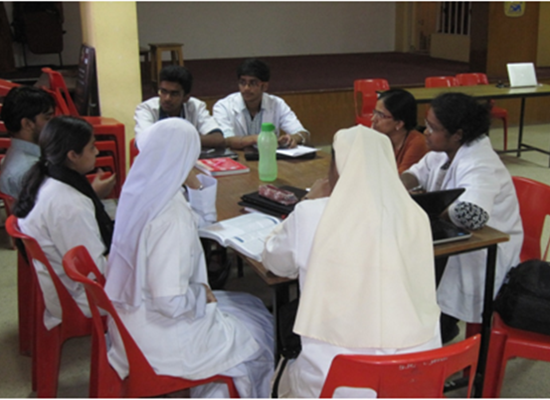
Problem based learning (PBL) is an educational method that is centred on the discussion and learning that emanates from a clinical problem. The small group setting used in PBL encourages an inquisitive and detailed look at all issues, concepts and principles contained within the problem. It is a way of learning which encourages deep understanding rather than mere superficial coverage of information. In the process of working in groups, students also learn valuable skills such as effective communication, teamwork, and leadership. These skills are not often emphasized in the formal curriculum, but are essential to becoming a competent clinician. The time spent outside of the group setting facilitates the development of skills such as literature retrieval, critical appraisal of available information and the seeking of opinions of peers and specialists. Problem based learning encourages students to become more involved and responsible for their own learning.
.jpg)
.jpg)
.jpg)
| For: Soft Skill Development, Language and Communication Skill Development, Personality and Professional Development, Employability Skill Development | |
| Year of Implementation 2011 | Faculty in Charge Dr. Mangala Rao |
Teaching is considered an art but training is necessary to acquire the skills. Medical teaching starts even when one is pursuing post-graduation. The department of Medical Education organizes a workshop in teaching methods for post graduates (PG) every year
It is a one and half day workshop. It includes sessions on domains of learning, creating specific learning objectives, lesson planning, use of media, teaching-learning methods including demonstration/practicals, bedside teaching and Microteaching. Each session is followed by a group activity where the participants apply what is discussed in the session and present it to the group. Skills necessary for teaching theory (lectures, tutorials etc.) as well as practicals (bedside teaching, demonstration etc.) are discussed. Also, the participants have one day to prepare for the microteaching session. They are divided into groups of 5 participants each and one faculty is in-charge of the group. Each participant presents a topic to the small group and receives feed-back from the peers and the faculty. This gives an opportunity to the PG to learn the skills in a non-threatening environment.
The aim of PG MET is to incorporate medical education as part of regular PG curriculum.
| For: Soft Skill Development, Language and Communication Skill Development, Personality and Professional Development, Employability Skill Development | |
| Year of Implementation 1973 | Faculty in Charge Dr. Bobby Joseph |
Understanding that previous batches of students did not necessarily fulfil one of the main objectives of the Medical College – which was to serve the health needs of medical underserved areas of our country, the Governing Board enlisted the 30 students from the Batch of 1973 to be the first to sign up for the Rural Service Scheme. From that year onwards students were required to sign a bond committing to serve in rural parts of the country and hence the common categorisation of these students as “rural bonders” came into vogue.
Every year approximately 75% of the students start the Social Obligation Service in one of the 350 approved centres. Sixty percent them complete at least 2 years of rural service. Over the years we have approximately 20% permanently serving in these underprivileged areas.
From February 2020, Dr. Bobby Joseph (Professor of Community Health) has been appointed as Vice Dean- Community Outreach. He coordinates the postings of the students as they complete their internship and also keeps in touch with the centres where they go on to work.
| For: Employability Skill Development | |
| Year of Implementation ---- | Faculty in Charge Department of Community Medicine |
The Pulse Polio initiative vaccinates all the Under 5 children in the nation at the same time, ensuring eradication of Polio. Every year, the Undergraduate students of St. John’s Medical College volunteer for this programme by assisting the Bruhat Bengaluru MahanagarPalike in the field activities of Pulse Polio initiative. Amidst the COVID 19 pandemic and the COVID 19 Vaccination programme for Health care workers during January 2021, the implementation of Pulse Polio 2021 was done from 31st January 2021 to 03rd February 2021. The students are trained on the activities of the programme was conducted by faculty from the Department of Community Health, St. John’s Medical College and health workers of the Madiwala Urban Health Centre on the following important aspects:
• Importance of Pulse polio vaccination
• Eradication status of polio worldwide
• Cold Chain maintenance and vaccination principles
• COVID prevention
• AFP, Measles and ILI surveillance as a part of the Pulse Polio The students are involved in both booth based (one day) and house to house activities(3 days) at the Pulse Polio drive.
| For: Soft Skill Development, Language and Communication Skill Development, Personality and Professional Development, Employability Skill Development | |
| Year of Implementation 1979 | Faculty in Charge Department of Community Medicine |
As part of their undergraduate training in Community Medicine, the students of MBBS Phase I at SJMC have been undergoing the Rural Orientation Program. This is a rural residential program for students conducted annually since January 1979.The program has been held now for over 40 years, from even before the Medical Council of India (MCI)’s Graduate Medical Education regulations came into force.
The aim of these programs is to sensitize undergraduate medical students to life in rural settings and to equip them with essential public health skills so that they become doctors who are sensitive to needs of persons in rural areas.
During the ROP, family and community study experiences enable students to interact with village folk and learn rural economics, education, occupation, housing, food, family life, local governance, child rearing and healthcare systems using topic guides. A daily review and presentation of their activities in the field helps students to improve communication skills. “Monsoons” – a simulation exercise puts students in the homes of village farmers and in their social situations. In the session on nutrition demonstration, students procure raw food items from the local village market and cook common nutritious foods. The “child-to-child” programme trains students to teach school children common health issues. The community programs, including street play, provides students with a platform to impart health education to the community. A module for step-by-step implementation of the ROP has been prepared to ensure quality and standardization of instruction.

Simulation Lab Workshops
| For: Analytical Skill Development, Personality and Professional Development, Employability Skill Development | |
| Year of Implementation 2018 | Faculty in Charge Dr. Nachiket, Dr. Soumya |
St. John’s Medical College, a premier institution well known for its excellence in medical education, strives to produce competent medical graduates who are compassionate and ethical. In its endeavour to continue this proud tradition amidst rapid societal and technological changes, the institution has set up an 1800 square foot state-of-the-art clinical skills and simulation centre. The construction of this centre was made possible by generous financial contributions by alumni and well-wishers of St. John’s. The centre is in the ground floor of the Robert Koch wing of the medical college adjacent to the Cardinal Gracias Hall, a well-known landmark amongst those who studied in St. John’s. Its vision is to be a centre of excellence for clinical skills and medical simulation training, with a goal of providing competent and compassionate patient care. Since its inauguration in 2018, numerous training sessions have been conducted for both undergraduate and postgraduate students. Additionally, a number of faculty development workshops have been organized.
| For: Soft Skill Development, Language and Communication Skill Development, Human Value Development, Personality and Professional Development | |
| Year of Implementation 2018 | Faculty in Charge Dr. Johnson Pradeep |
In the Covid era, online sessions were taken. In the Interns Ethics debates, interns are asked to debate on topical issues and take questions from the faculty audience too. In 2018, the PG ethics sensitization course was started for the 2nd year PGs. It was designed as a bimonthly programme spanning over 6 months. The topics ranged various aspects of ethics- clinical, research and personal. In its second year- due to Covid pandemic situation- the last session was held online. About 50 students fulfilled the participation requirements to get the completion certificate. For the Ethics MBBS classes done online- MCQs were done on GEMS. Students submit reflections and assignments as part of Foundation Course Ethics and AETCOM. An exam was held for PGs but many did not take it. Performance in MCQs is not mandated to get a pass, but is a learning exercise.
| For: Soft Skill Development, Language and Communication Skill Development, Human Value Development, Personality and Professional Development | |
| Year of Implementation 1964 | Faculty in Charge Dr. Johnson Pradeep |
St John’s always recognized the need for the emphasis on ethics in the training of a medical student. Even before ethics classes were mandated by the MCI in 2019- the Department of Medical Ethics conducted more 40 hours Ethics and Values sessions classes for MBBS students, in the 1st, 4th and 8th term. The topics were consistently reviewed to ensure it is relevant to the practice of medicine. An introduction to ethics was done during the Foundation course with the St. John’s Version of the Hippocratic Oath being read as a prayer by the students during the Orientation Programme. From 2019, in keeping with the MCI mandate 40 hours of Ethics in the Foundation Course, with the AETCOM (Attitude, Ethics and Communication) sessions of 34 hours in first year and 37 hours in second year have been taken. We also added relevant topics like creativity in doctors, dealing with stress and addictions amongst others. As the 2019 batch goes into their 3rd and 4th years- additional sessions will be taken as required. .
| For: Language and Communication Skill Development, Personality and Professional Development, Analytical Skill Development | |
| Year of Implementation 2013 | Faculty in Charge Dr. Pretish Kiran |
Objective Structured Clinical Examination (OSCE) is a reliable, standardised assessment tool which can be used to evaluate the skills of outgoing undergraduates. OSCE has been administered every year at the completion of internship in our institution since 2013. OSCE is divided into stations where each station tests a particular domain (cognitive/psychomotor/affective). It is used as a tool to provide feedback to the faculty and the institution on lacunae in training in undergraduate students. The advantage of the OSCE is that it is a standardised tool, with all students examined under similar conditions with identical problems as compared to a traditional oral examination. Each station is set up to assess students at different levels within each domain, and is formulated and manned by faculty from across the various departments. The post internship summative assessment using OSCE is an assessment of the teaching programme and identifies areas which need strengthening. The individual departments receive feedback of the students’ performance in the OSCE for re-evaluation of their teaching programme. It is also an indicator of student performance and individual students receive their scores to understand their strengths and weaknesses.
| For: Yoga and Wellness, Human Value Development | |
| Year of Implementation 1964 | Faculty in Charge Academic Section |
The Annual Retreat is organized by the academic section to bring together the students in an environment of secular prayer and reflection. The students participate in a 2 day programme in the first year, usually in the month of Feb. The retreat is lead by a team of qualified personnel and involves reflections, discussions and group activities. Sessions include meditation, prayer, singing, sharing of experiences, guided reflections, and an introspection of their role in society. The annual retreats have been well received by the students as it gives them a refresher from the classes and a time to spend with themselves away from the stress and routine of academic life. The retreat is conducted usually immediately after an internal assessment, when the students are relatively free from academic pressures. Faculty are also nominated to, be part of this experience. Lunch and snacks are provided to the students and the students are encouraged to interact with the retreat team during the breaks provided.
| For: Language and Communication Skill Development, Personality and Professional Development, Employability Skill Development | |
| Year of Implementation 2009 | Faculty in Charge Dr. Ishwar Bhat |
The importance of communication skills in the practice of medicine has long been recognised as one of the cornerstones of successful patient outcomes. Despite this, formal training in communication is not part of the formal MBBS curriculum and is part of the “hidden curriculum” with the assumption that the students will learn “on the go” in their clinical postings. It is only now that the MCI/NMC recognised this lacuna and introduce formal training in communication as AETCOM modules in the new Competency Based Curriculum(CBME). The need for the training in such soft skills for medical graduates was recognised long before the introduction of CBME by Medical education Department of SJMC. The MBBS students in St Johns undergo two workshops – A Basic Communication Skills Workshop(BCSW) and an Advanced Communication Skills Workshop(ACSW). The basic workshop takes place for 3rd term MBBS students just before they start the clinical postings and deals with basic verbal and non verbal skills required for effective patient communication. The advanced workshop is for 6th term students and deals with communication in difficult situations like dealing with angry patient, taking sexual history, communicating with elderly and with children.
| For: Soft Skill Development, Yoga and Wellness, Human Value Development | |
| Year of Implementation 2020 | Faculty in Charge Dr. ManjulikaVaz |
The Eternal Grove – Garden of Remembrance was inaugurated by the management of St John’s on Jan 29th,2020. It is a sacred space dedicated to the remembrance of those who have donated their bodies or organs to medical education and patients. On the occasion of All Souls Day, the student groups - Humanities Club and Ecologics under the guidance of the Health and Humanities Division started holding a remembrance function and prayer at the Eternal Grove from Nov 2, 2020.
This All Souls’ Day programme has become an annual function. The programme is held between 10 and 11 am and starts with an opening hymn by our medical student sisters, followed by a prayer service conducted by the Chaplain. Dr Manjulika from Humanities and Dr Stephen from Anatomy explain to the invitees the significance of the eternal grove, the remembrance function and the body donation programme at St John’s. Students from Ecologics, talk about the importance of remembering those who have helped in their education and describe the significance of the saplings chosen for the occasion. The special guests every year are family members of body donors who have passed away in the preceding year. They along with members of the Executive body of St John’s plant a sapling, light a lamp and share their feelings.
.png)
.png)
.png)
| For: Language and Communication Skill Development | |
| Year of Implementation 1979 | Faculty in Charge Mr. Nanjundswamy |
The MBBS course at St. John’s Medical College receives students from various states of the country. Hence the student population has a mix of various cultural and language backgrounds. These students eventually interact with patients and staff of St. John’s Hospital as part of their clinical postings, and at the St. John’s health centres as part of their rural postings. A significant number of these patients speak Kannada as their first language. The Institute conducts Kannada classes to enable students to communicate well with these patients. This programme was established in the earliest years of the Institute (before the University considered mandating language classes) and is attended by all MBBS students of the College. The classes are held as part of the first-year curriculum of the MBBS course. One hour per week of the first term has been dedicated to Kannada teaching. (Since the University mandate, 40 hours are dedicated to the programme.) During these sessions students learn basics of communication and medical terminologies in Kannada. The classes are compulsory with a minimum attendance requirement of 80%. The programme ends with a Kannada examination in which students are graded.